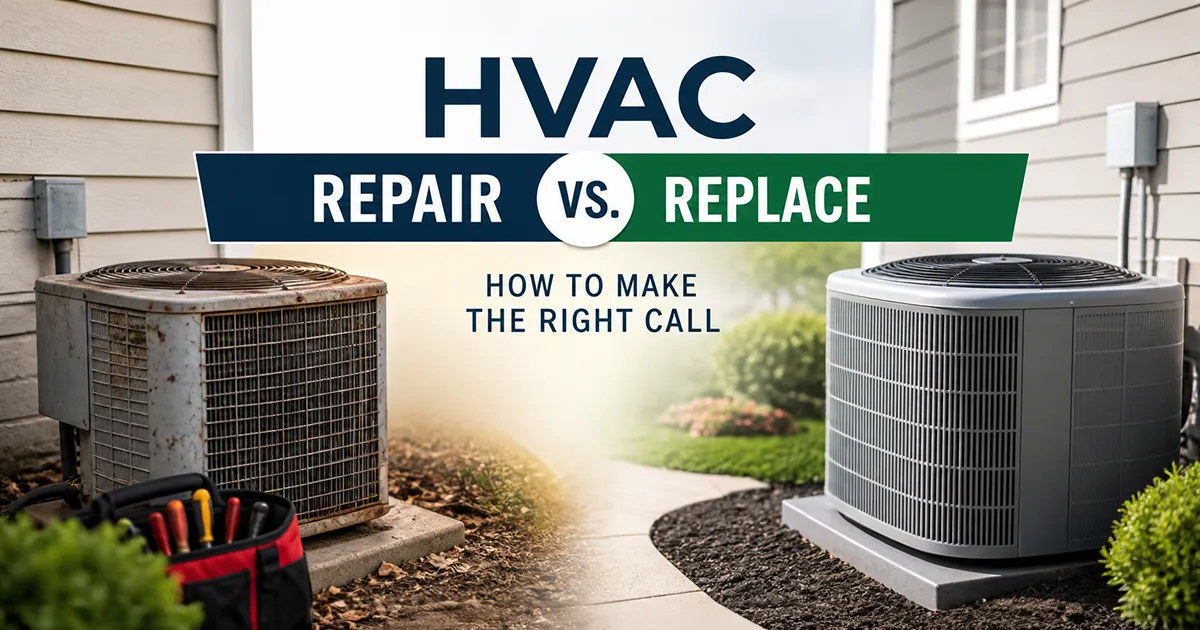
Your HVAC system never picks a good time to fail. It's always the middle of July, the coldest night of February, or the weekend before you're hosting a houseful of people. And right when you're sweating it out or digging out blankets, you have to make a decision you weren't ready for: do you fix it, or do you replace it?
That question is harder than it used to be. Energy costs are still squeezing household budgets. Systems installed 10 to 20 years ago are aging out of their useful life. Newer equipment has raised the bar on efficiency, comfort, and smart home compatibility. And homeowners who've been putting off a decision are now staring at repair bills that beg the question of whether throwing more money at an old system is really the smart play.
There's no one-size-fits-all answer. But there is a way to think through it clearly.
Your System Is Telling You Something
Before you decide anything, pay attention to what the system is actually doing. A unit that still kicks on isn't necessarily a unit worth keeping. Aging equipment often shows its age in subtler ways before it finally quits.
Are certain rooms never quite right? A bedroom that stays warm on summer nights, a corner of the house that never gets enough heat, a living room that feels damp and sticky no matter what you set the thermostat to. These aren't just annoyances. They're signs that the system is working harder than it should and delivering less than it's supposed to.
Watch the energy bills, too. If your usage habits haven't changed but your monthly costs keep climbing, the system is losing efficiency. It's running longer to do what it used to handle easily. You're paying more for the same result, or worse, paying more for a worse result.
Unusual sounds are worth taking seriously. Banging, buzzing, grinding, or rattling often signal mechanical wear that doesn't get better on its own. Musty or burning odors shouldn't be ignored either. A system that short cycles, struggles to hold temperature, or takes noticeably longer to heat or cool the house is giving you clear signals.
How Age Changes the Equation
Most central air conditioners and furnaces have a useful life of 10 to 15 years. Some last longer with consistent maintenance. Most don't perform as well in their final years as they did in their prime.
If your system is under 10 years old and has been reasonably well maintained, a repair is often the right call. A single issue on a younger system doesn't mean the whole unit is compromised. Parts can wear, components can fail, and a targeted repair can extend the system's life by several good years.
Past 15 years, that math changes. An older system that breaks down once will often break down again. You're not always dealing with one isolated problem. You're dealing with parts that have all been running for the same amount of time, and when one goes, others tend to follow. Spending significant money to fix an aging system can feel like putting new tires on a car with a failing engine.
A good rule of thumb: if the repair costs more than half the price of a new system, replacement is usually the better investment. That's not a hard law, but it's a useful gut check when you're staring at an estimate and trying to decide.
When a Repair Makes Sense
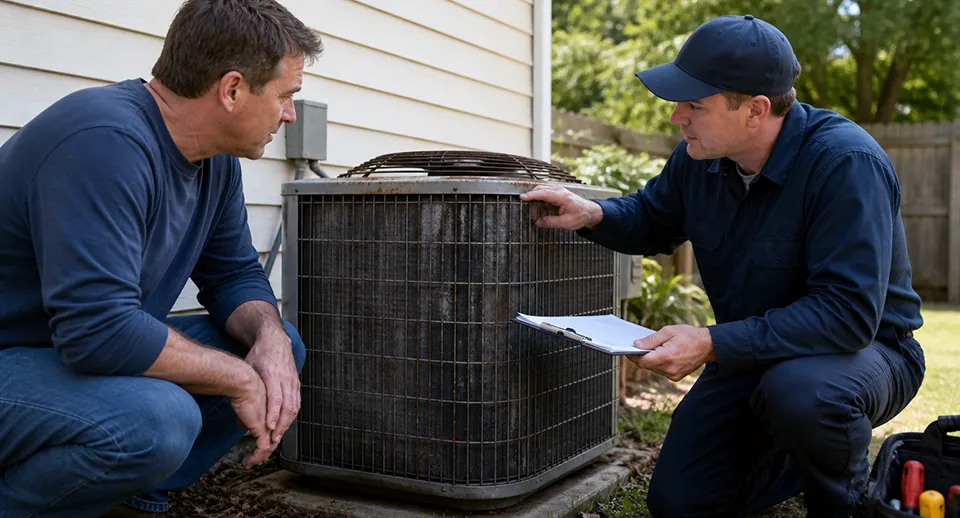
Some repairs are genuinely worth doing. A faulty capacitor, a clogged drain line, a dirty coil, a worn belt, a bad thermostat connection, these are relatively contained problems that one of our technicians can fix without it costing a fortune. If your system is newer, the repair history is clean, and the issue is isolated, fixing it is usually the right move.
Warranty coverage changes the picture, too. If parts are still covered, the cost of repair drops significantly. It's worth checking your paperwork before assuming you're on the hook for the full bill.
Some homeowners are also just not in a position to replace a system right now, and that's a legitimate consideration. A reasonable repair can buy time. It's not always the long-term answer, but it can be a practical bridge while you plan and budget for eventual replacement.
One thing worth checking before calling anyone: pull the air filter. A severely clogged filter can choke airflow, strain the entire system, and create comfort problems that look a lot like equipment failure. It's a simple fix that homeowners sometimes overlook.
When Replacement Is the Smarter Move
If you've repaired the same system two or three times in the past year, you're not really fixing it. You're chasing problems that are going to keep coming. That kind of cycle adds up fast, especially when you factor in the service call fees, parts, and the time you spend without reliable comfort.
Major component failures often tip the scale toward replacement. A failed compressor, a cracked heat exchanger, a blown blower motor, a failed evaporator coil, these repairs are expensive on their own. On an older system, they often don't make financial sense. You'd be making a major investment in equipment that may give you another couple of years before the next failure.
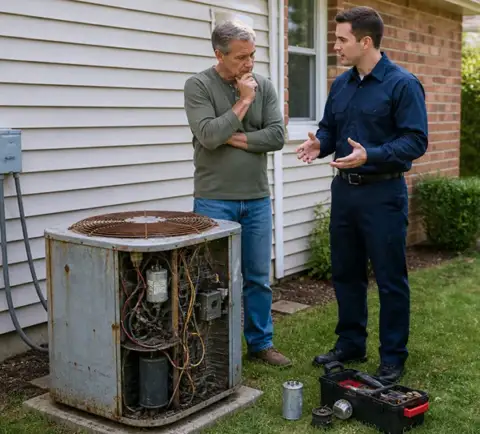
If your system still uses older refrigerant, repairs get more complicated and more expensive. As that refrigerant becomes less available, the cost to service those systems continues to rise.
Replacement also starts to look more attractive when you factor in what you'd gain. Modern systems are built to meet higher efficiency standards than most of what was installed 10 to 15 years ago. Many homeowners with older equipment see real differences in performance after upgrading, not just in monthly utility costs, but in how the house actually feels.
Variable-speed and two-stage systems run more steadily than older single-stage units, which tend to blast at full power, shut off, then repeat. That cycling creates temperature swings. Newer equipment maintains steadier conditions throughout the day, which makes a noticeable difference in comfort.
Smart thermostat compatibility is another consideration. Better scheduling, remote access, and energy monitoring give homeowners more control without having to constantly adjust things by hand. Modern systems are also generally quieter, and many can support indoor air quality upgrades, better filtration, humidity control, fresh air ventilation, that make a real difference for households dealing with dust, pets, or seasonal allergies.
Budgeting for Replacement
HVAC replacement cost varies based on system type, home size, efficiency rating, ductwork condition, and what the installation actually involves. There's no universal number, which is why getting a clear, itemized quote matters.
Higher-efficiency systems cost more upfront but typically cost less to run. Over several years, those operating savings can meaningfully offset the initial investment. Financing options can make replacement more accessible without requiring a lump-sum payment, and it's worth asking about available rebates, tax credits, or manufacturer promotions that might apply to the equipment you're considering.
One advantage of planning ahead rather than waiting for an emergency: you have time. You can compare options, ask questions, review financing, and schedule installation before demand spikes during extreme weather. Replacing a failed system in the middle of a heat wave means limited availability and a rushed decision. Planning in advance means neither.
Final Thoughts
The repair or replace decision comes down to the full picture, not just today's repair bill. System age, repair frequency, energy usage, comfort complaints, major component health, ductwork condition, and long-term plans all factor in.
A minor issue on a well-maintained system under 10 years old often warrants a repair. Frequent breakdowns, rising utility bills, poor comfort, aging components, and major repair costs on old equipment often point toward replacement. If you're unsure where your situation lands, a professional inspection by CAST Heating and Air Conditioning is the best starting point. Our technician will give you an honest evaluation, one that includes both a repair estimate and a replacement quote, gives you what you need to decide without guessing.
If you're weighing your options heading into 2026, don't wait for a complete failure to start the conversation. contact us today at (972) 955-2588 to schedule an inspection or get a quote. We'll take a look at what you've got, give you a straight answer, and help you make the call that's right for your home and your budget.